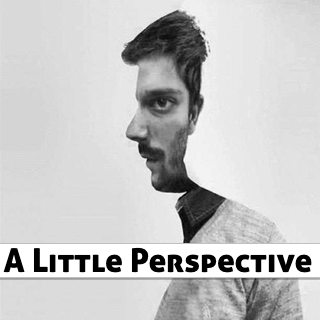
A Little Perspective

I have a secret.  It's not something I'm proud of, and it's not something I tell too many people.  OK, deep breath... I have been listening to conservative talk radio.  It's been going on for a few months now, ever since football season ended.  But it's not what it seems, I promise.    

I have been thinking a lot lately about perspectives.   How do seemingly intelligent people, armed with the same facts about any given subject, come to polar opposite conclusions? How can very smart people be atheists, and other very smart people be Christian, not to mention all the very smart people of other religions.  Or take any number of issues in politics.  Passionate people on both sides of the argument seem to have the same end goal in mind, but the debate quickly becomes a name-calling contest, with both sides accusing the other of being out of touch and ignoring the facts.  The level of vitriol that exists in politics almost negates any positive influence it may have. 

Like I said, I have been listening to talk radio latelybut is not something new for me.  I used to listen pretty often, and at that time, I largely agreed with the opinions being broadcast.  A lot has changed since then, and my social and political views have shifted pretty dramatically.  So listening to it again gives me a whole new perspective on some issues that I thought pretty much every intelligent person agreed on.  I'm not going to go into any of those issues (sorry political people), but I do want to share what I've learned about myself and about perspective in general. 

I realized pretty quickly, as I was yelling at my radio, that it's tough to love someone if you think they are an idiot, or more precisely, if you don't value and respect their opinions. And it is very difficult to value opinions if they are the opposite of your opinions.  Our natural tendency is to dismiss them as wrong, without much further thought or insight.  Everyone should agree with me, because I'm right. The funny thing, for me at least, is that my own opinions have changed over the years.  What I felt very strongly about a few years ago, I now believe the opposite.  I find that I can identify with the guy on the radio, even if I think he's wrong, because I was once where he is Believe it or not, keeping this in mind really helps to see where he is coming from, even if I don't agree with him. 

often see Christians who lack perspective.  Hard line anti-this or that, up on their moral high horse, making it look like Christ's love is the last thing on their mind.  When we are so opposed to some amoral behavior, we often lack the perspective to say, "I was once where he is." If you intend to follow Jesus, then your desire to have people behave morally must be secondary to your desire to love them.  Remember Jesus socializing with sinners?  He knew that loving them would make a difference in their lives, so he didn't care what the religious leaders thought.  They were concerned with making sure everyone followed the rules and morals of society. 

Recognizing that we've all been there, in the exact condition that the people we are looking down on, brings a sense of perspective.  "Love the sinner, hate the sin" is a favorite saying of the morally superior crowd, but moral superiority very often gets in the way of loving people.  I wonder if Jesus would have eaten dinner with those people that Christians tend to marginalize, like atheists, LGBTs, drug addicts, adulterers, illegal immigrants, Muslims, drunks, prostitutes.  If we keep them at arm's length, while Jesus embraces them, how can we say that we are sharing the love of Christ?  

Jeff Hyson

Jeff Hyson

To Face or Not to Face?

(By Tammy Vaughn)

I have been pondering the reasons that people choose to face their emotions or suppress their emotions.  I’ve listened to friends’ conversations and have noticed lately that many people suppress emotions and/or deny their feelings. People are generally proficient in talking about the facts of a particular situation but are not in touch with their feelings.  Instead, they choose not to delve into the emotional side of the situation.  It’s easier to talk about someone or something than take responsibility for how you feel.

Some may ask, “How do you know when a person is suppressing their feelings?”  I’ll answer the question with an example:  If someone calls an overweight individual “fat,” most likely it will cause some kind of negative reaction or feeling within the person targeted, whether that is embarrassment or hurt.  To say that it does not cause some kind of feeling is probably not likely or realistic.

There are times when a person does not realize that they are suppressing feelings.   This often happens when people do not take deep self-inventory.  They may be unwilling or unable to take the time to mine-out their deepest emotion.  Many people are fairly good at identifying happiness, sadness or anger.  However, that same group of people may not be so keen on identifying the varying intensity of their emotion.  For example, a more intense form of sadness could be depression.  A more intense form of anger is rage.  There are varying shades of basic emotions.

Some may deny that they are experiencing a particular kind of an emotion that is affecting them negatively.  This denial often happens because they feel embarrassed about the emotion.  They may feel like they are not entitled to feel the way they do.  Some people seem to be very concerned that if they give themselves permission to feel the emotion, they will not be able to actually deal with it.  According to James Gross, a scientist who studies emotions, “Suppressing emotions is hard to do and does not work.”  His studies have shown that once the emotion is triggered, it is very difficult to shut it down or ignore it. In fact, we become more tense and agitated while trying to suppress or ignore the feeling.  This shows that it is not emotionally healthy to suppress emotions.  Another negative implication of shutting off emotion is that people closest to us can tell we are suppressing our feelings; our non-verbal communication gives clues that we are hiding emotions, even when we insist on saying we’re fine.   In other words, in many cases we are not fooling anyone but ourselves.  This can actually do damage to the people we love; they end up feeling shut out because they know that we are experiencing feelings but are not willing to share them.

So, if it is not beneficial, what is the purpose of shutting down emotions?  What does a person hope to accomplish?  Often times, the person who shuts down or shuts off their emotions hopes that this action will make them appear to be strong in their vulnerable time of weakness.   This reminds me of the beautiful Bible verse that says, “My grace is sufficient for you, for my power is made perfect in weakness.” (2 Corinthians 12:9 NIV)

Other times people hope that by suppressing their emotions they can calm themselves down or help defuse a delicate and/or explosive situation.  The person does not wish to cause waves or cause a fight.  It does not usually accomplish what they want.

Usually feelings that are stuffed down come out in ways we do not want and at times we do not want.   Often we handle stuffed feelings in ways that are not helpful to us.  Stuffed feelings can be motivators to very negative behaviors or habits like substance abuse, physical and/or verbal abuse, etc.  However, when we give voice to our emotions we actually give validation to how we are feeling.  We feel grounded and more in control.  Healthy discussions about your emotions is just that, healthy.  It actually helps to bring your feelings to the light, which makes you better able to identify and deal with the source of the emotion.  If you can recognize the emotion, you can deal with the emotion.  You can respond to the situation as opposed to just reacting like a puppet on a string or a slave to a master.  Have you ever met a person who is ruled by their emotions?  If they feel a certain way then they have to act a certain way, never realizing that they may be a slave to their “un-dealt with” emotions.  Galatians 4:6-8 says, “Because you are his sons, God sent the Spirit of his Son into our hearts, the Spirit who calls out, “Abba, Father.”  So you are no longer a slave, but God’s child; and since you are his child, God has made you also an heir.  Formerly, when you did not know God, you were slaves to those who by nature are not gods.”  Our emotion, while important and valid, are NOT God.  And we should not be a slave to them.

Many things we suppress are not able to be processed by ourselves because we are stuck in our emotion.  At these times it’s advantageous to seek out professional counsel and begin to learn how to express those feelings and get them out in the open, aided by someone we trust.  Even the expression of those feelings to a close loved one is beneficial because it allows others to express care and empathy.  No one really wants to be burdened and suffer through a rough time alone.  Nor should they have to.  Open communication is one of the ways a person experiences a loving relationship.  Sharing your heart with someone you trust can greatly strengthen that relationship.  In the end, giving our loved ones a chance to show us they care and that they can be with us/there for us is actually a gift to them.


How Do I Deal With Shame From My Past?

What a great opportunity to deal with the reality of personal shame by having looked at the Cross during Easter. If your sense of shame still is lingering and it reaches back into your past, I recommend you listen to this video blog and consider the book "Shame Interrupted" by Ed Welch. Any tool that will help you understand the roots of that shame as well as how is it that Jesus addresses it in the most effective way is worth your time and resources. Here is a quote I want to put before you to "wet your appetite" for more liberating grace:

Here is the challenge. Your shame is about human relationships. What do other people think of you? Where can you fit in? Even now you could wonder, what does God have to do with this? The things God says are good, but they don't seem connected to the deeper issues. For example, if you are a public failure, it is good that parents or friends love you , but that love doesn't touch the rejection you experience. The love doesn't take away the failure. The acceptance of the King [Jesus], however, coupled with the knowledge of how to live before him, will diminish the power of shame. Other people might not yet recognize that your public failure has been replaced by kingdom humility and honor, so you still might hear a few mocking voices. But those voices can't reach as deep, and they certainly won't last. (page 148)

Click here to listen another thought the author of this book offers to us.

Failure Is (Not) An Option

failure_is_not_an_option_by_vikesinha-d3a4gzr.png

It’s been a rough month.

It started with the flu. I woke up on Sunday morning one week and was a coughing, feverish, shaky mess. I decided after two days that being sick was not an option for me and dragged myself to work. It took me about ten minutes to realize that “mind over matter” wasn’t going to work. I was sick. Really sick.

Failure #1.

Yes, the flu was a failure to me. I couldn’t will it away. I was caught in its grasp until the virus ran its course. I had no control. I couldn’t work or be productive in any way. 

Upon my return to work, I realized that I was seriously behind on EVERYTHING…lessons, grades, other assorted paperwork. I sheepishly assured my bosses that I would get caught up within the week.

Failure #2.

Yes, being behind was a failure, too. I live to appear competent and in control. Now I didn’t look like either one. It felt terrible.

But I put a plan together. I would be in control once more! I plowed through my work, got things done. I had the perfect plan to be done by the deadline I gave my bosses, and it was HAPPENING. My world was in order once again.

Until I woke up that night with the unmistakable symptoms of either the world’s nastiest stomach bug or food poisoning. I’ll spare you the details, but you can imagine that the next day was not productive as far as work. 

I was still behind. Failure #3.

I eventually made my deadline by the narrowest of margins, but everything else in my life was out of order: my house, my relationships, my budget and tax filing. All had been neglected thanks to my illnesses and the zeal to get my work life together.

 I tried to get it together once again. I was filing my tax return…and reality hit. I made a mistake. A big mistake. A mistake that cost me a lot of money. I calculated, recalculated, researched. Yup. I had underestimated my taxes, and it was too late. I had to pay up with my savings. 

Failure #4. I NEVER make mistakes with taxes. Ever.

I spent a good part of that day curled up in a ball of defeat. My life had become, in my view, a disaster. Nothing was going well. Nothing. I kept asking God, What is this? A joke? A punishment? What are You doing here? I don’t get it.

And I’m still not sure I get it completely, but I’m seeing a pattern throughout all of these “failures.” Each one is based on an expectation of perfection from myself. I need to appear in control of my life at all times.  Mistakes and weaknesses are not OK.

During the current sermon series on The Everyday Gospel, we’ve learned a lot about limits and boundaries. It’s a different world entirely from the perfectionism I strive for. The idea that God deliberately sets limits on our lives is one that is far, far away from performance based Christianity. Thinking about God this way turns the events of the last month completely around.

 If I begin to think that all of these “failures” are really a part of God’s plan to shape me and limit me where I need limiting, then my attitude automatically refocuses on Him, not myself.

I’m just starting to really grasp some tough but important Truths: That life’s failures don’t define me. That circumstances beyond my control, like the flu, are not reflections of my weakness. That setbacks don’t break me. That mistakes happen and are survivable. 

And most importantly, that a gracious God is in charge of everything.

Nancy Vasquez

Nancy Vasquez


My Top Ten List for Thoughts on Beauty

    My daughter Ava is three years old, and she just loves to wear dresses. Everyday she asks me, “Mommy, can I wear a dress today?” And I usually let her wear one. But recently, she’s started asking me a new question each time she puts on a dress. She heads to the mirror and asks, “Mommy, don’t I look pretty now?”

    It breaks my heart to see my daughter starting to enter more fully into the lifelong relationship every woman has with beauty: a relationship both with their own beauty and with what the world says about beauty. As a mom, I so wish I could protect her. I wish I could download and program into her little mind a philosophy about her image that would spare her the hurt and struggle that women go through in this area.

I know I can’t. But IF I could, I’d use my little ‘brain programming software’ to instill these top ten convictions that I’ve come to (through a lot of suffering) into her little heart (but minus the suffering).  

Sarah’s Top Ten List 

for what I’d want engrained in my daughter’s heart about Beauty

  1. We tend to think that the way beauty works is that there’s a specific list of qualifications that you have to cross off a list in order to obtain it. Either you have beauty or you don’t. In our culture, we’ve established a definition of beauty: being skinny, having a good figure, certain facial features, the niceness of our house, the trendiness of our clothes, and so on and so forth. However, I’d want my daughter to come to realize that our definition of beauty is NOT the same as God’s. God made women, (and I do mean ALL women) to be beautiful. That’s just the way we are. We possess it; beauty is in our essence. I sometimes already tell my daughter Ava, “You’re so pretty. Guess what? So is your sister Bethany. So is your Nana. So is Mommy. Your friends Myla and Bristol are pretty, too. Every girl you see around you is pretty. God just made girls to be pretty. That’s just the way they are.”
  2. Why are women beautiful? Well, the reason we are beautiful is because GOD is beautiful. In the beginning, when God decided to make people, He decided to display His image in people. He made two genders to display different characteristics of Himself, and a dominant thing He designed women to display about Himself is…beauty. So, if you’re a woman, you can’t NOT be beautiful. It’s like a birthright. We’re born into it. It’s just who you are: you ARE beautiful. Because God is beautiful. 
  3. I don’t need something else to make me beautiful. I am beautiful. Period. Clothes don’t make me beautiful. Being young doesn’t make me beautiful. Makeup doesn’t make me beautiful. Being ten pounds skinnier doesn’t make me beautiful. There’s not an equation that says ‘Me + <insert something else, such as a bigger chest, or makeup, or the cutest clothes> = beautiful.’ No! If there’s any equation, it goes ‘Me + NOTHING = beautiful.’ And, again, it’s because of God, The Beautiful One, making women to display His image, that we’re beautiful.
  4. Also. My beauty can never be defined in comparison to someone else. The beauty that’s on MY life is personal, particular, and unique. It’s not an ideal cultural list of criteria. It’s a gift from God. For example, has this ever happened to you: you feel good about your outfit until you reach the party that you’re going to, and all of the sudden, you hate what you’re wearing? It’s happened to me too many times. Or recently, I’ve been working on exercising daily and I feel good about my body getting more in shape. But I can feel like a fat, ugly blob when I see someone who is skinnier than I am. Or have you ever tuned in to notice the images everywhere in our world that are screaming at us what it means to be beautiful and what standards we have to achieve? But my beauty can never be defined in comparison to someone else. It can’t be measured by our culture’s definitions. My beauty can only be defined in relationship to God. 
  5. The Beautiful God has specific reasons for making beautiful women. He has purposes for our beauty! He wants our beauty point people to Himself. My beauty is not a chance to prove to everyone that I’m the best. But we’re like little wildflowers who might make someone think of the Creator. Our beauty is to point back to Him. That’s kind of theoretical. But here’s a purpose that’s pretty tangible: our beauty is supposed to create a safe place for other people. Our tendency is to use our own beauty to make ourselves feel safe. But God gave it to us to make others safe. 
  6. How do we use our beauty to make ourselves feel safe?? It can look so many ways. It’s a pretty sneaky temptation, in my opinion. For example, I’ve struggled so often with having the wrong motives for making my house cute and well decorated. A good word for what it feels like deep inside is striving. And I do that striving to prove to myself that I’m feminine enough, a good enough woman. And I’ve wanted friends to think the same. I used the gifts of my personal taste (which IS beautiful) to find a sense of security in my identity. Or I’ve certainly picked out clothes to make myself feel safe. I’ve thought if I’m trendy enough, I’ll be wanted as a friend. Or I won’t be rejected. And I’ve been afraid that I’m ugly and I’ve worn makeup to cover up my face to give myself a sense of security. I’ve striven to be skinny thinking that if I weigh more than I’d like to, I’m scary place where I might lose something valuable…my security. It’s like I’m trying to save myself from the scary place of being unwanted or unloved by being beautiful enough, both in what I look like and in who I am. 
  7. What will it feel like for other people when I follow the temptation to use beauty for my own safety? Well, it will hurt them. I’m actually going against the design that God has for my life. I’m actually creating more unsafe places and feelings for others. When we strive after the ideals of needing to be skinny, having a perfect house, never aging, and so on, we’re perpetuating the lie that beauty is a list of criteria. We’re just one more voice saying that you can’t rest in who God made you to be. You have to change the way you are and strive, strive, strive, to try to grasp an illusive security that will never actually feel safe. The Biblical term would be that we’re encouraging others to chase after ‘false gods.’ I can think of an extreme example of this: think of an actress who is playing a role in a movie that includes nudity. If you’re watching a movie with a sexual scene in it, and you’re next to your husband, do you feel safe? Nope. You feel very unsafe…and compelled to strive harder so that you can be safe in an unsafe world. The actress is using her beauty in a way that’s attempting to secure some kind of safety for herself (fame, the label of ‘sexy,’ etc) and it creates an unsafe environment for the rest of us. It’s going against the design for a woman of creating safety.
  8. So now that I know that I’ll be tempted to use my beauty to secure safety for myself…but that God’s design is for me to make others feel safe…how can I do that? What does it look like? Well, one thought I have is that it looks like putting limits on myself in the area of beauty. We’ve heard some sermons about this idea of limits on Sunday mornings at LFA, and I think it’s very applicable to beauty! For example, we learned 3 ways we can know we need to impose a limit on ourselves. The first was if I’m trying to be more than human. That’s certainly applicable to beauty. We have the pressure to try to: live up to a supermodel standard of appearance, lose ‘baby weight’ at a super-human speed, keep an immaculate house, stay looking as young as I did when I was 21, keep the same body that I had pre-babies, always look perfectly put-together, and on and on and on. Or the two other ways we can know we need a limit were if we’re trying to live someone else’s life (do you have an ‘arch-nemesis’ that you’re always trying to live up to?), or when we just want something too much (being skinny? a bigger house? pottery barn furniture? perfect family pictures? no wrinkles? a six-pack by summer?). When we find tendencies such as these in ourselves, it’s a GREAT time to impose a limit on ourselves.
  9. And what might a limit on myself look like? It might look like coming to terms with my post-babies body and being kinder to myself in my movement towards health instead of striving so hard to be as skinny as possible. It might look like a more balanced, calm approach to my diet. It might look like changing my focus from a perfect house (that I’m trying to get to prove my identity), to creating a house that will feel safe and welcoming to people who enter it. In fact, getting that welcoming and safe feel might have more to do with me working on myself and who I am on the inside and how much I’ve listened to the Hoy Spirit’s desires for this person than with my actual house. It might even look like using my energy to get people into my house, aka using my energy to look for who I can love and get to know. A limit could look like choosing not to wear something immodest that looks great on me. It could look like not dressing as trendy as I possibly can and being more normal. A limit can look so many ways, but it will create a safe place for other people, a refusing-to-strive-place
  10. One other way of using beauty to make others feel safe is kind of the opposite of imposing a limit. It’s intentionally offering who I am. When I hide and try to change who I am, it’s yet again trying to manipulate safety for myself. But a woman who trusts that God has made her beautiful, both inside and out, and that who she is will be a gift to those who get to know her because God made her and God lives inside of her, will be a gift of safety to people. She’ll be emanating rest. There will be a lack of striving. She’ll be a safe place that points others back to God. When she is restful in the way God made her, believing that she is innately and uniquely beautiful, she can proactively use her beauty to minister to a hurting and confused world. She has nothing to prove. 

So there you have it. My top ten list for thoughts on beauty. Unfortunately, I don’t have a secret brain programming software. But even so, I do pray that God would give my daughter Ava, me, and also you, grace to walk in His design for beauty. 

Sarah Howard

Sarah Howard

Big Question! Where does it say Jesus Hopped??

(By Lois Robinson)

Growing up, Easter was always a big deal in my house. I would look forward to getting my new fancy Easter outfit, which included a little white hat, purse and little black patten leather shoes. The night before Easter, I would dream about what would be in my Easter Basket , how big it would be and what kinds of candy it would be stocked with. I always wanted the biggest chocolate bunny!! The song was always a favorite as well....

“Here comes peter cottontail, hopping down the bunny trail, hippity hoppin’, Easter’s on its way....”  Easter day would come, we would dress in our fancy Easter clothes, sit in “our” seat in church, sing the standard “easter” songs, hear the same ole message about this guy Jesus died on the cross and came back to life in 3 days and so on and so on. All we looked forward to was getting out of there, eating candy, the big Easter dinner that only came once a year and the Easter Egg Hunt that would follow. Yay, let the party begin. The Jesus thing was a formality that had to be acknowledged but the Easter bunny, Easter dinner and the Easter Egg Hunt was what it was all about for me. That is what I was taught. I even remember that the church Easter program had the Easter bunny hop right up the center isle of the church as everyone sang the hippity hoppin' song.

Let me not fail to mention, I was raised in a “Christian” home. 

          As I am writing this blog, very real emotions rise up inside of me of anger, sadness, confusion. Two of the most significant events in history , one being the birth of Christ and the other being the work He did on the Cross and His Resurrection......diluted down to a party involving food, an imaginary figure and a gift. Oh God, please forgive us.

Another set of emotions I am experiencing are humbleness, thankfulness and comfort. You may be asking how can I feel such contradicting emotions at once. It is very possible.....as you look below the surface you will find out:)

I am so thankful that as I have gotten older, failed a lot more and learned from those things, Jesus has shown me deeper truths about the Cross and His resurrection. I used to think it was a one time thing when I got saved but it is an everyday thing. Everyday I am a sinner, but everyday I must remember that my status changed on that Cross because of Jesus. Not because of WHO I am or WHAT I’ve done . It’s all because of WHO JESUS IS AND WHAT JESUS DID AND WHAT HE IS CURRENTLY DOING AND WHERE I FIT IN HIS STORY!

The more I get nearer to Him and He gets nearer to me, I am reminded of how ugly my sin was and is. When that reality really sets in, the Cross of Christ and His Resurrection evokes deep emotion in me. When I literally allow my defenses to drop, get quiet before Him, think of the UGLY things I have done and been apart of by choice.... and some not by choice.....and to know He literally died for all of that willingly without me even asking Him to do that for me......and then on top of that......GOT BACK UP IN 3 DAYS in order to give me the victory everyday over all those ugly things that held me down.....WOW!!!!!!! How can that not give you chills!!!

So, I am not presenting a challenge this time. I am giving a directive this time. Please do not make Easter all about the stuff I mentioned in the beginning of this blog. None of it served to bring me life, forgiveness or freedom. I am not anti- food, anti -eggs, anti- rabbits, anti- candy or anti -gifts. But I am anti-idolatry. Whenever we make anything or anybody bigger than the One who is to be Celebrated...........it leads to bondage. How you may ask:) Using my own experience from the beginning of this writing, since the primary emphasis in my family was on the party, the food, the basket and the egg hunt, the “life or emotional high”  I experienced from the celebration was over by the next day. It was a form of entertainment without substance or truth. So when I encountered hard times later in life, I had virtually no understanding of why Jesus really had to die, what significance that had on my sin/circumstances and how His resurrection impacted my ability to break out of patterns of daily brokenness and sin. That is a HUGE reality I never learned as a child because “Easter” was  about everything else but Jesus and the work He did for me and everyone else on the Cross. Consequently then, I walked around in bondage for a long time without knowing the true reality of Easter and its implications for my life. The Freedom that was waiting for me based on the Reality of the Cross. I tried many many things to experience freedom and none worked for longer than a day...if that. But, when I got serious about Looking below the surface ..........I began to learn what the Significant event of Easter was and IS all about. Amen

Know what you are celebrating and why you are celebrating it!


How To Cope With Suffering?

(By Diego Cuartas)


Suffering is such a part of our human existence and though this is the case the presence and experience of it still affects us and shapes us in ways beyond our calculations.  Suffering remains a purposeful reality within God's plans for our lives. Therefore, it is important that we lean on a godly framework to face it and walk through it. Today, I want to share a good resource produced by Ed Welch, from CCEF, on this topic. May God use it to encourage you and bless you in the difficult places of your life.

Click here to read this article on "Ten Things to Do During Suffering".


The Freedom of Limits

babydedicationfeet.jpg

This past Sunday was an exciting day for me because my brother and sister in law dedicated their baby daughter in the second service. Ara Faith is pretty much everyone’s favorite person right now and it was incredibly special to stand up there with Dan and Holly as they declared that Ara belongs to God. 

I thought that was that, but after the service I started connecting the dots between Ara’s dedication and Nate’s sermon about knowing our limits and how God wants the gospel to shape our limits. 

It’s so easy to take what God calls our limits and call them something else instead- like failure or incompetence or not trying hard enough. We’re a culture of go-getters and nothing is supposed to be able to stand in our way. Of course, that isn’t how it really works and we end up discouraged and frustrated, always a few steps away from the life we think we’re supposed to have or the person we think we’re supposed to be. 

Despite that reality, finding freedom in my limits still seems like a ridiculous contradiction. I think it’s because I usually associate freedom with independence, and independence means I control everything and never have to give up. (I’m pretty sure that kind of thinking reveals that being American shapes my theology more than the Bible does, but that’s a WHOLE OTHER STORY.)

Okay, back on track- finding freedom in our limits. I can’t think of a better practical example of the joy and blessing that comes from knowing your limits than what I saw in Ara’s dedication. I loved seeing the tangible action that Dan and Holly took because they know they cannot give Ara everything she needs. They cannot completely protect her; they cannot shape or control her or her life to make it perfect or happy. They acknowledged that reality and gave her back to God and in doing so they experience the freedom of not having to perfectly accomplish those things alone. 

I’m not a parent but I do know that nothing is ever that easy and simple. But I think maybe that’s the beauty of knowing your limits. Limits don’t mean the end of everything, they’re just the end of our capabilities and the place God can step in and do something more. 

I’m excited to begin this process of embracing my limits – not as failures – but as opportunities to step out in faith and know that God will meet me there. 

Jessica Noblett

Jessica Noblett

The Heart Of Approval

(By Thor Knutstad)

Sometimes we so desperately need each other's approval.  Unfortunately, fear and worry are so connected to how much we crave approval and how much we hate failure.  Whatever you think you need will always control you.  If you need love and acceptance and approval from others, they hold the keys to something very valuable to you.  You will live in fear that they might not deliver.  You will fear those who are the gatekeepers to the fulfillment of your needs.  This can control your heart, your conversations, your goals and even your relationships.

The opinions of other human beings are by far the scariest things on the planet.  Our formula for avoiding rejection deceives us into thinking that we can win the approval, the prestige or the love that we desire.  But God doesn't want us dominated by the opinions of other people.  His approval, by far, is all that we really need - and we have that in the Gospel of the Lord Jesus Christ.  You see, God the Father approves of the work His Son Jesus did - and that changed and changes everything.  God's approval reigns over me because of my Savior - not because of others and not because of my performance.  I can rest in this great truth. Praise Him.


Good Intentions Awareness

Last fall, during Breast Cancer Awareness Month, pink was all the rage.  Working in a school, I noticed several coordinated days where staff and students wore pink ribbons, bracelets, or other articles of clothing.  I wondered if the students knew why they were wearing pink, so I asked an 8th grade boy.  "It's for breast cancer," was his response.  Cancer awareness is a noble cause, but is awareness enough?  Is wearing pink really helping anything?   

Before you answer, consider this:  Giving money to cancer research and wearing pink both have the same effect on the person doing the action.  We feel good about ourselves, we feel like we have done our small part to help, and, more importantly, we feel absolved of any further responsibility, at lease until next year.  But doing something noble that costs us nothing, and doing something noble with some personal cost are not equal. 

I was talking with an old friend recently, whom I hadn't seen in quite a few years.  I knew from our limited Facebook interactions that he had been involved in a church plant a few years ago, and that he is now pastoring that church.  So, after the initial pleasantries of, "How is the family?" and "Where are you living now?" etc., I asked, "How is that church thing going?"  He responded that, about six weeks ago, they had taken around 30 members of his 3 year old, 175 member, church and planted a new church a few miles away.  My response of, "Oh, really?  Our church has been talking about planting new churches in our area for a little while now," was met with a polite smile.  It was the smile I give people when I tell them that I develop mobile apps, and they respond with, "Oh yeah? I was going to try doing that, but I never really got started." 

I know our church has a vision for planting churches, and just because I'm not "in the loop" on the latest church-plant news doesn't mean things are stagnant.  But in the time that I have been hearing about our future planting plans, my friend has planted, grown, and planted again.  It's easy to say that I think planting a new church is a great idea, but have I volunteered to go help start that church? Nope.  Having noble intentions that cost me nothing is not the same as doing something noble, and costly.  In fact, like cancer awareness pink day, feeling good about our intentions can be detrimental to our action. 

If this sounds like I'm being harsh or pointing a finger at others, let me let you in on a secret.  I do this all the time.  I drop my 15 cents change into the charity bucket at Wawa, and feel like I did something.  Did I make someone a meal?  No.  Did I show compassion or love to someone.  No.  I might watch a YouTube video about some crisis on the other side of the world, then post it to Facebook for all my friends to see.  I feel pretty good about it, but it didn't cost me anything.  I talk, talk, talk about social justice, but rarely do anything about it. 

So what's the point?  I think we need to be aware that good intentions are not the final goal.  Let's call this "Good Intentions Awareness Month."  In our feel-good society, it's easy to get the feeling of making a difference without making any difference at all.  We are called to be the salt of the earth, but if that salt intends to season the food, but never actually makes it into the recipe, what good is it?  Let's let our actions speak louder than our words, even if our words sound pretty good.

Jeff Hyson

Jeff Hyson


Toxic People

Who are they, anyway? 

My son-in-law has a saying which could describe the relationship we might have with someone who is not very good for us. He says, “When you put your gloved hand in the mud, the mud doesn’t get glovier!” And that is about what happens. If you have grown children I’m sure you can remember a new friend who seemed to be a bad influence on your child, or maybe it was just a bad combination of the two of them. Maybe new words suddenly appeared, or lying, or candy bars when he had no money! Upsetting, to say the least! And we think, “My goodness, is he/she so weak that just anyone can drag him around?!” 

But it’s not a matter of weakness, or, more realistically, it’s a weakness we all have, child and adult alike. The difference with a child is that he has no wisdom to recognize poor choices; choosing his new friends himself is all new and exciting to him. And his character is pretty much unformed.

With adults, it’s pretty much the same process, except that we ought to know better. We know when our actions change with different folks. We know when we adjust, not for the better, to fit in with some people. Yes, we know when we are not obeying the scripture which tells us that “whatever you do, do to the glory of God.” And we surely can be expected to listen to the Holy Spirit and to make better choices. We need wisdom and discernment; if we lack wisdom, God has promised to give it to us, if we just ask Him.  And we need that wisdom. Satan knows exactly where our weaknesses are, and that’s where he will tempt us. We don’t need to work up the strength ourselves to resist temptation. God’s strength is manifested in our weakness. He says so. Ask Him.

On the other hand, if you worked on the genogram a couple of weeks ago, you may have had to recognize and name a different kind of toxicity ----- the kind that has the power to damage us  and change us in situations we were never prepared to face. There may be ones who have the power to hurt us so badly that we have to separate ourselves from them for good. And with some of them, that solution is not completely possible.

My parents are both dead, so I can tell you a little about my story. My father had a very disruptive childhood. He was an orphan, and was adopted by a young Methodist pastor and his wife, who soon after both died in the flu epidemic in the early nineteen hundreds. There was some money, so for the rest of his childhood he was in court-supervised foster care, and who knows what happened to him there. We think he had no example of a good father as a child; certainly as an adult he was not a loving father. He gyrated from anger and suspicion to over-indulgence, and we never knew which it would be. He did not know how to love, except in one way: when I was grown and married and had two pre-teen daughters I discovered that he liked to kiss little girls. 

I have no idea when my mother discovered this charming pass-time --- surely much earlier ---  but she was very good at keeping her head in the sand like the proverbial ostrich when it was something she could not handle, so she was essentially a gifted enabler. I had never heard the word “pedophile,’ and I would be glad to tell any of you more about this terrible time in my life, but for now I will just say this: that that was when, to me, my father died. I will not go into the anger and betrayal and hatred I felt. It was impossible to cut him completely out of my life, but for the rest of his life I treated him with distant respect, essentially putting on an act for the rest of the world. When he actually died many years later I did not mourn; I had done my mourning, for more than his death, many years before.

Of course I do so sincerely hope that none of you ever have to experience anything like this, but I know that many of you have, though perhaps in a different way. And my very best advice to you is to get counseling! A good counselor has heard EVERYTHING, believe me, and would be so very much help in guiding you through it to a more healthy place in your life. You deserve it, and I am sure God wants you healthy, and both emotionally and spiritually mature.

Life is so messy. I know that God weeps with us when he sees the terrible things we do to each other, and I know that He longs to hold us and comfort us when we are so terribly hurt.  He does comfort us and gives us peace. And I know that there will be a day when all tears are wiped away, and all sin is gone forever. Come, Lord Jesus!

God bless you all.

Norma Stockton

Norma Stockton


In Dealing with Sin

(By Diego Cuartas)

I think it is important that we look at our personal sin in a way that we consider the Gospel and its benefits. Two initial thoughts come together in my mind about this:

1. If I don't look at my sin through the lenses of the gospel I will be tempted or prone to rely on a false gospel to deal with my sin. A false gospel can be a person, an experience, or a specific resource whether cognitive or material. The goal here is to come under the benefits of the Gospel rather than pursuing a strategy that could give me a sense of "righteousness" apart from Christ and what He has secured on my behalf (Ro 10:3-4, 2 Cor 5:21, Gal 2:21, Phil 3:9, Titus 3:5, 1 Pe 2:24, 2 Pe 1:1). One danger in dealing with our sin is to put ourselves again under the curse of the law (Gal 3:10) or the curse of trusting our own flesh (Jer 17). Either approach will place us under bondage.

2. It is important that I seek the grace of God for my life in my sin so that I don't look for grace substitutes else where (Gal 2:21, 1 Cor 1:4, Titus 2:11, 1 Pe 5:5). What we lose when we seek grace substitutes includes things like true repentance, personal growth, true humility, and the experience of what Jesus provides to us through specific grace.

When dealing with our sin, we should consider looking at few important things:

My reaction to my sin, my responsibility to others, and my response to God. These three groups are important because sin does not happen in a vacuum, sin happens in the context of God--as my reference point to any holiness and righteousness--others--as the ones impacted by my actions--and me--as the one where sin originated at.

Here are a few questions to process our own sin:

1. how am I dealing with my sin and it's impact in my own life?

2. what grace is God providing me? what promises can I lean on for the future?

3. what wisdom do I need in dealing with how my sin has impacted others?

4. where is obedience being hindered? how can I grow in repentance and faith?

5. how is my knowledge and love for God increasing? how is my identity being shaped by my experience of God and His revelation? what provisions can I count on in God?

My hope is that we can grow in dealing with our sin without missing the Gospel or the Grace God can only provide for each one of us. I am convinced that grace is not a generic reality--it is specific and it is more than capable to address the details and needs of our real time moments.

For further reflection: 2 Peter 1:3-4

" His divine power has given us everything we need for a godly life through our knowledge of him who called us by his own glory and goodness. Through these he has given us his very great and precious promises, so that through them you may participate in the divine nature, having escaped the corruption in the world caused by evil desires."


YOU WON’T CHOOSE ME

(By Tammy Vaughn)

Recently my band, Dana Isles and Facedown, went to Knoxville, TN to record a six song EP.  When you record a song you tend to hear it over and over again.  As I listened to it over and over again, the words to one of the songs got me thinking about a lot of areas of life and the people in those areas.

The song is called “You Won’t Choose Me.” It is written from God’s perspective of how He (Jesus) pursues us and loves us yet we don’t choose Him.  When I first heard it I thought it was very sad.  In fact, I still think it’s sad because the song does a great job of highlighting how some people simply do not choose Jesus.  Some of the words to the song are the following:

“Many are Called, Called to follow Him but a very few choose to believe

I have chosen you but you won’t choose me

I try, try, try to make you love me, but you won’t choose me,

I can’t stop thinking of you, but you won’t choose me,

I knock, knock, knock and you won’t answer, you won’t choose me,

I just want to tell you that I paid your ransom but you won’t choose me

What more can I do to get through to you

You just don’t realize for you I suffered and died

To prove, I love you.”

This song hits me between the eyes every time.  In fact, I get teased some because I cry almost every time I hear it.  The simple Gospel is that while we were yet sinners Christ died for us.  Since that is the case, why is it that many people choose to reject the things of God, His Word, His guidance, His pursuit of them to follow their own sinful desires?  I mean honestly it had me examining myself to see in what areas I reject the things of God.  

At times, I think it is very easy to reject God and not even know you are doing it, but what I have been saddened by recently is that there are some who willingly choose to reject God’s commands.  Often this is because God’s commands keep them from pursuing what they think they want.  Following God is simply not what they want to do.  Some of the rationalizations are as follows:

  • It’s okay to violate God’s commands because I am tired of my life the way it is.
  • God can’t really expect this of me because it goes against the grain of what society thinks is acceptable.
  • I want to party, live it up gratify my evil selfish desires, after all, God wants me to be happy. Right?

Whatever happened to following God’s commands and honoring Him no matter what our desires are?  I realize it is hard to follow God at times; however, it is the way we show him that we love him.  The Bible says in John 14:15, “If you love me you will keep My commandments.”  We show our love to God by keeping His commandments.  So if we don’t keep His commandments, then we love something or someone else more.

My heart breaks because as I reflect I have realized that many - NOT ALL - but many of the situations I encounter on a day-to-day basis stem from choices being made to gratify self, turning away from God’s commandments and the promises He makes to us as believers in His Word.  The other heart breaker is that there are some that God is chasing and pursuing, yet the response given is to ignore Him.  Flat out reject and ignore Him.  Many wonder why, while they have exchanged the truth of God for a lie, they are living a miserable life.  Often God’s best is given up for insanity- repeated cycles of un-health that do not stop and contain one defeat after another, powerless living instead of powerful ability to live out the calling Jesus has on each of our lives.

The sad part of all of this is that there are consequences for these choices both in the here and now and in eternity.  Often times we are in a mess because of our own choices.  While in the mess we choose to reject God’s commands, making the situation worse or more complex.  It’s frustrating to watch and realize that we each have free will and make our own choices.  God can and wants to help us make the right choices. “He wants to give you power from on high but we don’t choose Him.”

It’s time to reflect on where we are in this.  So where are you?  Are there areas in your life or mine that we reject God?  Are there those around us that are choosing the world’s view or their own sinful desires over God’s desires and commands?  Does it break our heart?  Do we pray for them?  Do we prayerfully confront sin?  The Gospel of Jesus Christ is alive and well, giving power to all that believe.  So let’s live like our lives and others depend on it!

“Choose Me” copyright Dana R. Isles 2011


Confessions of a Serial Procrastinator

procrastination1.jpg

I’m sitting here at my desk at home on what feels like our hundredth snow day. A teacher’s work is never done, and I have a pile of papers to grade and lessons to finalize.  

I’ll probably do pretty much none of it today. Ok, I’ll finish my lesson plans because they are due tomorrow morning. But the stuff that doesn’t HAVE to be done now? That’s another story.

Procrastination has been the story of my life. My time management skills are awful and have been since childhood. I don’t want to be this inefficient, but it always seems to just happen that way. I have had a million resolutions swearing that I will be better next time. I will have a plan in place. I will be self-disciplined. I WILL DO BETTER. I WILL.

Then comes the inevitable failure and the self-shaming. You said you could do better, Nancy, and you have FAILED. Again. Just like you always do. 

I know that I am not alone in this mindset. Self-defeating inner dialogue is a part of many of our lives. Pastor Greg pointed it out in Sunday’s sermon about King Saul. A lot of us spend our lives feeling “small” and gathering evidence that our perceptions of ourselves are true.

The question of identity is an easy one to speak and a hard one to follow. I’ve been able to say that my identity is rooted in Christ for what seems like forever, but have I really LIVED that way?  When so much of my life is rooted in thinking about where I fall short, I’m not thinking as a daughter of the almighty God. I’m centered on me, me, and more me, not my Father. I am happy or sad based on what I am doing right or doing wrong. It has nothing to do with God. I’m giving the right answers but not living them.

The utter selfishness of the sin nature always wants to rear its ugly head, no matter how much we claim to know differently that it isn’t about us. We have Good News; the Creator of the Universe has redeemed and adopted us as His! But that Truth gets lost in the day to day self-chatter of all the control we think we should have in our lives. Absolute beauty gets lost in the petty ugliness of the human mind.  

Actually saying and knowing you are adopted as a son or daughter of God takes a daily, systematic fight against wrong thinking. Prayer, Scripture, Community, Counseling…all are great tools to battle wrong mindsets. But it is a daily, lifelong process, one that ebbs and flows. Rooting identity where it belongs is ongoing. 

My habits of procrastination are far from cured. But I can stop thinking about them as reflections of my worth.  They aren’t. I am not my habits, flaws, failures; I am a daughter of the King.

Nancy Vasquez

Nancy Vasquez

Why I Love the "Magic" of Lent

2010-02-lent-big.png

As strange as it sounds, when it comes to things that come around every year, the Lenten season is my favorite. I get excited about Lent the way kids feel about Christmas and the coming of Santa Claus. My senses tingle with anticipation. It feels magical.

I don't embrace Lent because it's religious or because I have to. Sometimes Lent is only seen as part of a list of rules that need to be followed and I just don’t see the point of that. I see Lent as an opportunity and you certainly don’t have to take it.

How I experience Lent changes year to year and I usually decide based on what I've been noticing God doing in my life. 

Sometimes Lent is about me adding something to my life: more time meditating on God’s word, more time with community, etc.

Sometimes it's about sacrifice that will remind me to turn to God instead. For example, if I give up caffeine, I have an opportunity to remember Jesus and that He is all I really need every time I crave a cup of coffee (that really is just an example, I haven’t been brave enough to try it.) 

Sometimes I sacrifice because even something that can be good has become too big in my life and I need to take a step back. This is usually the most difficult for me because it touches on things like social media or how I spend my money.

The bottom line is giving Jesus some extra elbowroom. I want more space in my life for Jesus to move, to speak and to shake out what shouldn’t be there. 

One year in college I gave up Facebook for Lent because I recognized it was taking up a lot of my time. A couple weeks later I broke my fast just to make sure a guy had my phone number. Now if Lent is about rules and only rules then I broke my fast and I’m a failure and that’s the end of that. But I love the idea of Lent being an opportunity for Jesus to clean house. I’m so thankful I broke my fast because it opened my eyes to a much bigger area of sin and control in my life- needing people to tell me what I’m worth.

I get so excited about Lent has the potential to tangibly display the essence of the Gospel- that Jesus doesn’t get boxed into only fixing what we think needs fixed. Jesus isn’t limited to whatever I think I need. Lent is just me taking a step in the right direction, making my own minuscule attempt and having faith that Jesus will do so much more. 

By the way, what I said earlier about Lent feeling “magical”? That might not be the right word but “Holy” definitely is. Lent is all about the anticipation of Easter- reminding us that Jesus came to earth and changed everything and He’s promised to come back. Why not start the celebration early?!

Jessica Noblett

Jessica Noblett

KAAABOOOM!! The Battle Against Hopelessness

(By Lois Robinson)

This time of year causes folks to experience higher levels of hopelessness, depression and suicide than any other time of year. After the holidays are over, days are shorter, nights are longer, and the snow, rain and sleet keep falling. With those dynamics comes a heaviness that is not easily lifted. Some try new patterns of healthy living to deal with the “blues,” which is always a recommendation. While others, on the other hand, take the unhealthy route of engaging in sinful patterns to relieve the emptiness.  The latter route would be called finding a “simple solution” to a complex problem, thus leading to a more complex problem. The enemy loves when God’s people do that. The byproduct from this behavior is hopelessness, which can lead us down a very destructive road.

I wanted to offer some helpful recommendations that will hopefully help you avoid the pitfalls of hopelessness. 

1.  BIBLE VERSES WRITTEN ON 3X5 INDEX CARDS - 

This practice is so powerful. The bible says, “I have hidden your word in my heart that I might not sin against you.” Psalm 119:11

Get in touch with the feeling(s) you have. You may get thoughts and feelings confused. A feeling is one word. An example:  “I feel ...happy, sad, rejected, abandoned, scared, excited, angry, lonely.

A thought, on the other hand, is a string of words. An example: “I feel sad because I wanted to go to my TFL class but another storm came!   (Feeling)    (Thought)

When you SERIOUSLY begin to learn scripture AND BELIEVE IT TO BE TRUE :), it WILL change your life. It doesn’t work like magic and fix everything in that moment just because you read a scripture, memorized it or even spoke it out. I have learned that I have to repeat it over and over again, because I am literally battling my flesh to come under the Authority of the Word of God.  In an anxiety ridden moment for me, I have had to sit and repeat a scripture regarding fear for 30 minutes or so until my mind believed what God’s word says over what my mind is believed at the time, thus producing all the anxiety! It is not a quick fix, friends. I have learned that deep down my flesh has trouble bowing to the Truth of God. My natural tendency is to see reality through MY eyes and believe it, which caused fear and anxiety. Oh God save me!

2.  VERSES HANGING IN STRATEGIC PLACES : HOME, WORK, CAR, COMPUTER, TV, FRIDGE:

This is another weapon of warfare that can change the atmosphere of your environment. I find that I need a daily reminder of who God says He is and who God says I amas I work, play, read, watch TV, rest and the list goes on. The same principle applies though: you must believe what the scripture is saying. You cannot just read it like it is the right thing to do and God will then somehow change it all. He desires you to trust and believe He is telling you the truth. When you practice believing and resting in His truths, things really do begin to change, whether in your circumstances or in your heart!

3. PRAISE AND WORSHIP MUSIC: THE SHOUT!

As one of my favorite worship leaders, Darlene Zschech says in her book Extravagant Worship“A shout commands attention. A shout is prophetic and faith building; a shout calls things that are not as though they were. A shout demonstrates enthusiasm, confidence, and determination. A shout releases energy, boldness, and passion. A shout changes the atmosphere. God’s word tells us to shout. “Shout to God with the voice of triumph and songs of joy!” (Psalm 47:1) She goes on to say, “When I am leading worship, I don’t shout to get people excited or “hyped up”. When I shout, I am encouraging people to put action to their faith.”

Amen and Hallelujah! Friends, someone told me that sometimes your healing is locked up in your praise. I believe it and have experienced deep healing in my life, mind and soul because of praise and worship. Scripture is loaded with events of people giving their praise, worship and surrender to Jesus and then experiencing healing. When Paul was thrown into prison, the bible tells us he prayed, praised and witnessed, the earthquake came and the chains fell off. Let’s learn to practice these weapons of warfare! Amen

Lois - Blog.png
 

Heart Checklist

heart-checklist.jpg

I spent some time this week trying to look over my heart and sort of take stock. It’s easy for me to get caught up in what I hear, or think I hear, God saying in the moment so I think it’s important to step back every once in awhile and look at the big picture. (Actually, it’s probably important to that more than every once in awhile.)

Here’s what came up: I am most consistently convicted about the way I spend my time and the way I use my words. 

Honestly, that’s nothing new. It’s sort of like running through a checklist of things I’m still bad at. It’s roll call and we’re all still present. 

I want to be a person who loves well. But that doesn’t start the way I often think it does.

This time, however, I started connecting the dots in a way I don’t think I have before.

I tend to spend my time pretty selfishly and the thing is, my time is not all about me. I guess it’s not really “my” time at all. Because I know from experience that love changes everything and a first step to loving someone is making time for them. It’s like we’re biologically incapable of not responding to that kind of love. When someone doesn’t just tell you, but shows you that you’re important, it changes you. Everyone wants to be loved, appreciated and accepted and we all respond to attention. 

My time is about loving people well but I think my words are linked to something deeper inside: being a person capable of loving people well. After all, from the overflow of the heart, the mouth speaks.

What I’m realizing is that the role of the Gospel in my life isn’t mostly about me pointing other people to it. It’s easy for me to try to simplify the Gospel into “salvation” or even me living my life in ways that show other people who Jesus is. But I’m still in the middle of my own redemptive process of letting the Gospel change my life too.
I know that sounds a lot like textbook Sunday School recitation but the practical implications are huge. It means submitting my heart to Jesus’ total redemption because without it I’m no good to anyone.

I’ve been thinking lately about 1 Corinthians 10:23 where Paul says, “’All things are lawful’ but not all things are helpful.” (ESV) 

Okay, fine, that makes sense but I like this version better from the Message: "Looking at it one way, you could say, 'Anything goes. Because of God’s immense generosity and grace, we don’t have to dissect and scrutinize every action to see if it will pass muster.' But the point it not just to get by. We want to live well, but our foremost efforts should be to help others live well."

That comes down like a hammer in my life. Hard. So often I just want to get by. I want to take advantage of God’s grace and take a sick day. Honestly, it’s especially true when it comes to the words I use. It’s so easy for me to shrug it off with a “there’s grace for that” attitude. And there is. But that isn’t the point. To once again, quote C.S. Lewis, “(I) thought (I was) going to be made into a decent little cottage, but He is building a palace.”

Every time I try to halt construction because I think it isn’t a big deal, it doesn’t give me more time or ability to love someone else. I’m just as inept as ever. 

I want to be a person who loves well. But that doesn’t start the way I often think it does- by managing my time or biting my tongue or any other number of actions. It starts exactly where I don’t want to look, my own heart. 

Jessica Noblett

Jessica Noblett